Structured disagreement to improve truth approximation in medical decision‑making.
Independent AI agents debate a clinical case — exposing uncertainty instead of hiding it — and produce a structured synthesis for clinician review.
Most AI systems optimise for agreement.
We propagate disagreement.
That is where signal lives.
Clinical decisions are rarely simple. Guidelines standardise care — complex cases expose uncertainty.
Multidisciplinary teams are essential to modern oncology. But the meetings that decide care can be slow, inconsistent, and vulnerable to the room.
Slow
Scheduling, preparation and throughput limit how many cases get full deliberation — and how deeply.
Inconsistent
The same case can resolve differently depending on who is present and how the discussion unfolds.
Groupthink
Hierarchy and early anchoring suppress dissent — the disagreement that carries the most clinical signal.
A pipeline that turns one case into many reasoned positions — then one accountable synthesis.
Input
A clinical case is admitted to the system — history, imaging, pathology and prior decisions — and normalised into a shared evidence frame every agent reasons from.
Many independent agents reason from the same case. They challenge each other's assumptions.
A moderator evaluates competing arguments on their merits — not their volume. The system produces a structured synthesis that makes its reasoning, and its uncertainty, legible for clinician review.
 Fig. 04 — independent observers, shared field
Built first for cancer MDT decision‑making. Initial domain: thyroid cancer.
Designed for real multidisciplinary cases and validated with clinicians — focused on uncertainty detection, reasoning transparency, and genuine clinical usefulness. A reasoning layer that grows from one tumour board to the whole field.
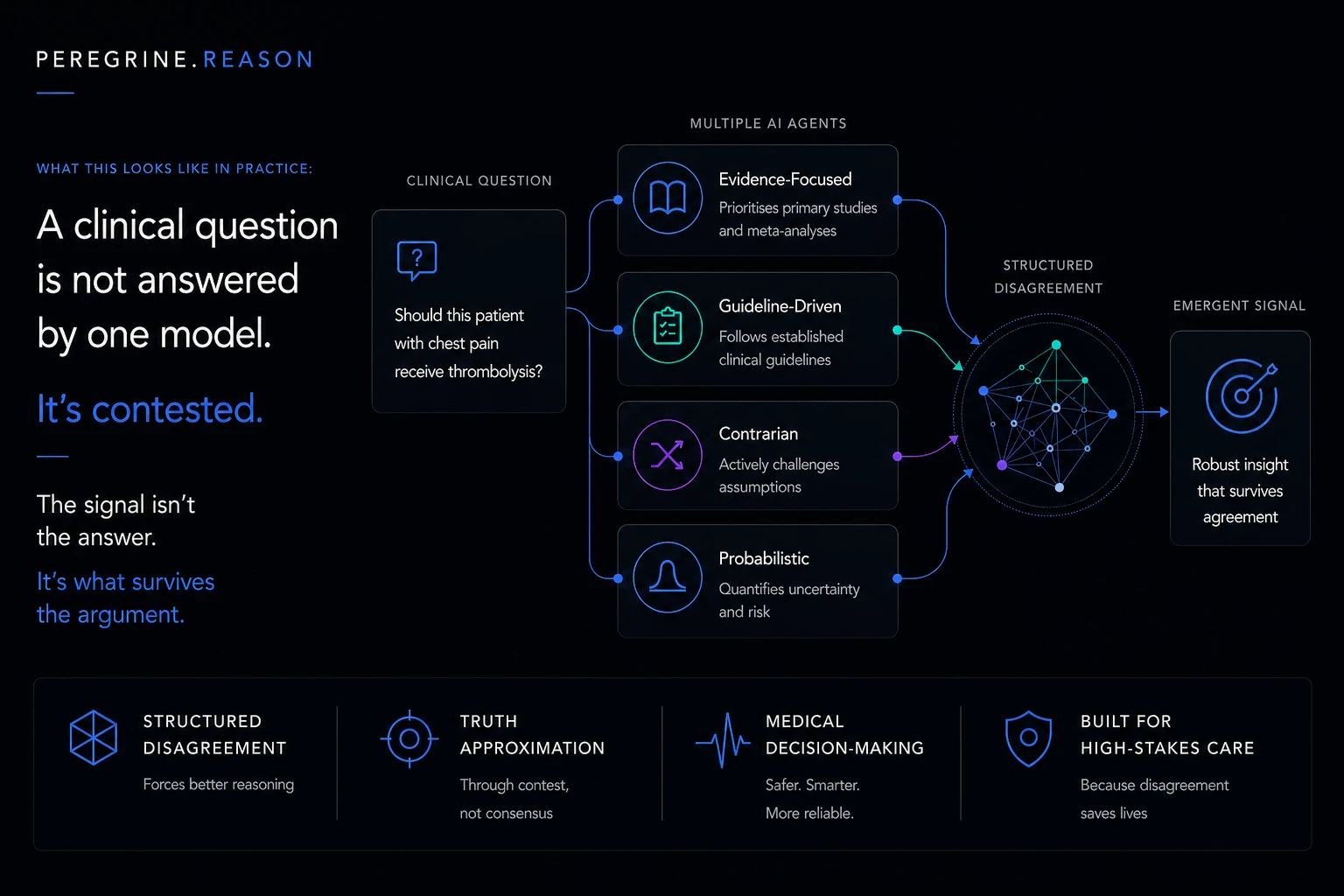 Fig. 05 — domain entry: thyroid
Clinical decision support — not autonomous diagnosis. The clinician always remains responsible for the decision.
Tested on real MDT cases with thyroid cancer clinicians, measuring uncertainty detection, reasoning transparency and clinical usefulness.
A new reasoning layer for multidisciplinary medicine.
We expose the disagreement that good decisions depend on — and make it usable at the point of care.